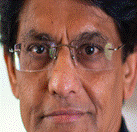
 Ashok Patel, PhD (Computer Science)
https://www.umassd.edu/directory/apatel38/
Professor (Associate Teaching) of Data Science & Computer Science, College of Engineering, 302B DION building, P: 508-999-9184, ashok.patel@umassd.edu
University of Massachusetts,
Dartmouth Campus.
===========================================================
Current Research Interest:
My research interests are at the crossroads of Cybersecurity and Artificial
Intelligence / Machine Learning Algorithms. Safeguarding data in the age of AI and building secure AI
applications are challenging. Integrating Security from the start is vital to
developing a secure AI/ML development lifecycle. AI/ML security management is
about creating security for AI agents in cloud environments and infrastructure.
My latest research focuses on protective monitoring for sensitive data
exposures by crawling from AI models.
Research Plan:
Bounding Injected
Reasoning Cost in LLM Agents:
An agent reads things from outside: web pages, documents, the results of tool
calls. An attacker can write text into any of those. The usual worry is that
the text makes the agent do something wrong. Recent papers show a second use of
the same trick: the text makes the agent, or the guardrail that checks it,
think far longer than the task needs. The answer is still correct. It just
costs far more, and the system becomes too slow and expensive to use. Reported
effects include up to 46 times more reasoning tokens, 13 to 63 times more
tokens in guardrails, up to 148 times the latency, and up to 658 times the cost
per query. A cap on thinking does not fix this. When the cap is hit during a
safety check, the system must either let the action through, so the attacker
gets through, or block it, so nothing runs.
What is required to build: Claim 1. No checker that
looks at one run with a fixed set of tests can tell induced cost from real
cost. A planted hard problem and an honestly hard task leave the same trace.
Claim 2. Work can be charged reliably to “trusted” or “untrusted” only if
untrusted text is read by a separate model with its own budget. This is CaMeL's two-model design, used for cost instead of data.
Claim 3. With that separation and a budget per tag, an attacker who controls
only untrusted text can raise the cost by at most the limit. When the untrusted
budget runs out, the text is marked unverified and cannot authorize an action,
so nothing slips through and the task does not stop. The proof is not written
yet.
1) Link to
published peer-reviewed research articles on Google Scholar:
https://scholar.google.com/citations?user=NdvEZDsAAAAJ&hl=en&inst=8491034277084204831
2) ORCID Link https://orcid.org/0000-0002-4027-5530
----------------------------------------
-------------------------------------------
-----------------------------------------------
Current MS Students under Direct Supervision (with thesis)
|
Sushanth Keerthipati |
|
Predictive Cyber Defense in IoT: A Hybrid Quantum GNN with MAML
Adaptation and QRL-Based Agentic Response; |
|
Joel Vanta |
|
Peer-Group-Aware Anomaly Detection for Credential Misuse in Enterprise
Authentication Logs |
Past Students: (at UMass Dartmouth)
|
Neda Farahmandi |
2024 |
Earthquake Prediction: Irregular Time-series Forecasting with Deep Learning |
|
Pooja Chigurupati |
2024 |
Transfer Learning in Adversarial Attack
Across Graph Neural Networks |
|
Devcharan Naik |
2025 |
Adaptive CTGAN: Enhancing Synthetic Data Generation for Imbalanced Cybersecurity Datasets |
|
Pranavi Nadipall |
2026 |
Inner Speech Decoding from EEG: A Comparative Study of
Deep Learning Architectures for Brain-Computer Interfaces |
Past Students (at Florida Poly)
|
Brett Glendenning |
2021 |
A Hierarchical Blockchain-Based
Approach To Secure Intelligent
Transport Systems in 5G |
|
Jacob Stevens |
2021 |
Robust, Effective, Applicable Detection of Fake Fingerprint: An
Anti-Spoofing System for Fingerprint Recognition |